Update: The NDIS released a revised version of the new Pricing Schedule, effective as of 24th September 2026. A link to the latest version can be found at the end of this blog.
Each year, the NDIA releases information on NDIS changes that may be implemented from 01 July. This includes what supports are available, how much they cost and how providers need to bill for them. This year, there are some important changes to unpack.
Using the information released by the NDIA, we’ve broken down what changes effective as of 01 July and highlighted the most important information. Some changes are straightforward, others need further action. Particularly if you're a provider or accessing Supported Independent Living (SIL).
Changes to Pricing Arrangements and Price Limits
- Name Change: ‘Pricing Arrangements and Price Limits’ will now be known as ‘Pricing Schedule’.
- Claiming rule descriptions have been removed: Provider Choice is waiting on further information from the NDIA about where those claiming rules will be published, which we will keep you updated on.
- Supports are now grouped by Provider type: If you’re a provider, you can find the support item codes that are relevant to you without having to dig through the whole document.
Changes to Support Worker Rates
The price cap for Support Worker services has increased. The NDIA has also introduced 4 intensity levels (levels 1 to 4) that reflect the complexity of support being provided. The hourly rate will be determined by the level of support.
If you use Support Worker services, your provider will be able to tell you which level applies to your supports.
Changes to Allied Health Rates
Note that changes to rates are dependent on the type of service. The key changes:
- The ‘Other Professional’ category has seen a significant reduction.
- Exercise Physiology and Dietitian rates have slightly decreased.
- Psychology and Behavioural Support rates have increased.
- Most other Allied health rates remain frozen.
The NDIA has also introduced new Support Item Numbers to better distinguish between types of Allied health services:
- Cancellations.
- Non-face-to-face (NF2F) sessions.
- Provider travel.
- NDIS-requested reports.
- Telehealth.
Providers will need to familiarise themselves with these codes to continue billing correctly. For participants, this won't change much day-to-day, though you may notice invoices are broken down in more detail than before, giving you more clarity about exactly how providers are using your funding.
Changes to Short Term Accommodation (STA)
Short Term Accommodation has shifted from a single all-inclusive daily rate to separate line items: one for support hours and one for participant and worker accommodation.
The practical implications of this change are still being clarified by the NDIA. An addendum is expected. If you or someone you support uses Short Term Accommodation, it's worth checking with your provider as more details become available.
Update: Naming note. The NDIA renamed this support Short Term Respite (STR) in October 2025, but the 2026-27 Pricing Schedule has reverted to the original Short Term Accommodation (STA) terminology. Until the NDIA confirms which name is sticking, you may see both in circulation. They refer to the same support.
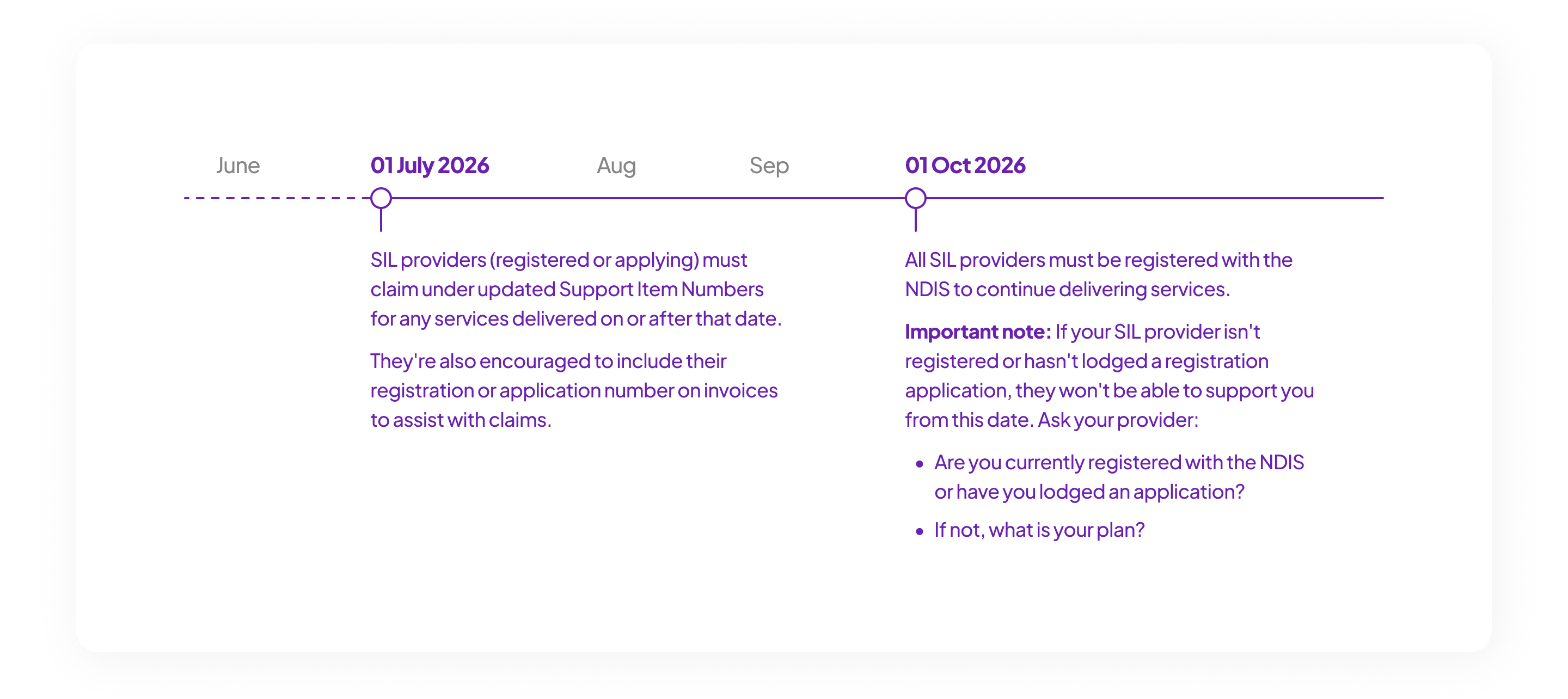
Changes to Supported Independent Living (SIL)
If you're accessing Supported Independent Living (SIL), there are some important changes worth knowing about.
We’re Here To Help
The NDIS is a complex system. While some changes are administrative, others have real implications for participants, families and providers. Provider Choice is committed to releasing plain-language updates as the NDIA confirms more detail over the coming weeks.
The easiest way to stay informed is to subscribe to our newsletter. If you have any questions about what we've covered, you can also book a Guru session.
References:
NDIS | Pricing arrangements
NDIS | SIL claims and payment changes from 1 July 2026