
Update: Naming note. The NDIA renamed this support Short Term Respite (STR) in October 2025, but the 2026-27 Pricing Schedule has reverted to the original Short Term Accommodation (STA) terminology. You may see both in circulation. They refer to the same support.
NDIS have been making changes to Short Term Accommodation over the past few months. You may have noticed that they trialled a name change to Short Term Respite, however after listening to feedback, they’ve returned to the original name: Short Term Accommodation (STA).
The most major changes have happened with the implementation of the NDIS Pricing Schedule, completely changing the way that it’s claimed. Below, we’ll outline the current NDIS stance on STA so that you can claim confidently.
What is Short Term Accommodation (STA)?
STA is designed to give participants a break from their usual care arrangements for at least one night. It also allows their primary informal carers to take a break so that they are able to continue in their role long-term.
Primary informal supports is the term the NDIS uses for people who support participants without expecting payment. They may include family, friends and carers.
Who can use it?
Adult NDIS Participants who:
- Live with their primary informal supports, or get daily drop-in support from them.
- Gets more than 6 hours per day of disability related support from their primary informal supports.
Child NDIS Participants who:
- Have disability support needs that are beyond what is typical for their age.
- Families will benefit from the support in order to continue providing care long term.
If participants have sufficient paid supports who provide consistent care and share responsibilities, the NDIS will not typically fund STA. For example, if a participant is accessing Supported Independent Living services.
Can you claim it?
STA invoices can be a hefty expense, so you’ll want to have all your ducks in a row before the bill arrives.
It’s important to check your NDIS Plan. Look for wording around “Short Term Accommodation” (sometimes also called “Short Term Respite”) in your NDIS plan and check for the below:
- Check if your NDIS plan specifies that it’s included. If so, also check for any specifications about what’s covered.
- Check if your NDIS plan specifies that it’s excluded.
If it’s not been mentioned at all in your plan, it will be crucial to discuss with your Local Area Coordinator (LAC), Support Coordinator and/or Plan Manager before you go ahead. You’ll want to ensure that they have a copy of your current NDIS plan so that they can give you the right advice.
How it works
If participants are funded for STA, NDIS will include this in their flexible Core budget. Typically, NDIS will fund up to 28 days per year, with a maximum of 14 consecutive days in one stay.

Respite supports must be similar to the support which a participant usually receives at home and participants must not double up with other supports which are funded in their plan.
Participants should only be paying for the supports that they’re actually using.
What’s covered
With the introduction of the NDIS Pricing Schedule, the NDIS has made significant changes to how STA is claimed.
From July 1 2026, NDIS will separate STA claims into three parts:
- Cost of participant accommodation.
- Cost of Support Worker’s accommodation (if required).
- Cost of Support hours (This is the supports needed to help you do everyday activities, like showering, cooking and toileting and is typically delivered by a Support Worker).
This means that NDIS will no longer cover any expenses that fall outside of the three parts above.
What’s not covered
- Cruises, holiday packages, holiday accommodation and airfares.
- Passports, visas, or travel and vehicle insurance.
- Accommodation or travel expenses for family members or support workers who are providing you with support on holiday.
- Theme parks, music, theatre, cinema, sporting events, conferences and activities that happen during the STA stay.
- Food or meals.
NDIS also advise that STA cannot be used for holidays or to replace normal parenting responsibilities, normal time apart, participating in community activities or mainstream community supports. For more information on this, you can read NDIS | Short-term accommodation.
Note: If you’re going overseas, your NDIS supports don’t have to stop completely. Take a moment to check out our blog to learn more: What Happens to Your NDIS Plan When You Go Overseas?
Crisis accommodation
NDIS have specified that STA cannot be used for crisis accommodation.
If a participant is at risk of homelessness, they can contact their LAC or Support Coordinator for help to apply for state or territory housing or homelessness services.
Where it can be taken
Participants can use it in individual or shared settings, or even their own home, depending on their needs.
- Standard accommodation such as a hotel, motel, short stay rental, cabin, cottage, hostel or respite accommodation.
- The participant’s own home, if it helps the participant have a break from their primary informal supports.
- Generally, STA should happen in the participant’s home state/territory. The NDIS may make an exception to this rule for participants who live in remote areas or a border town.
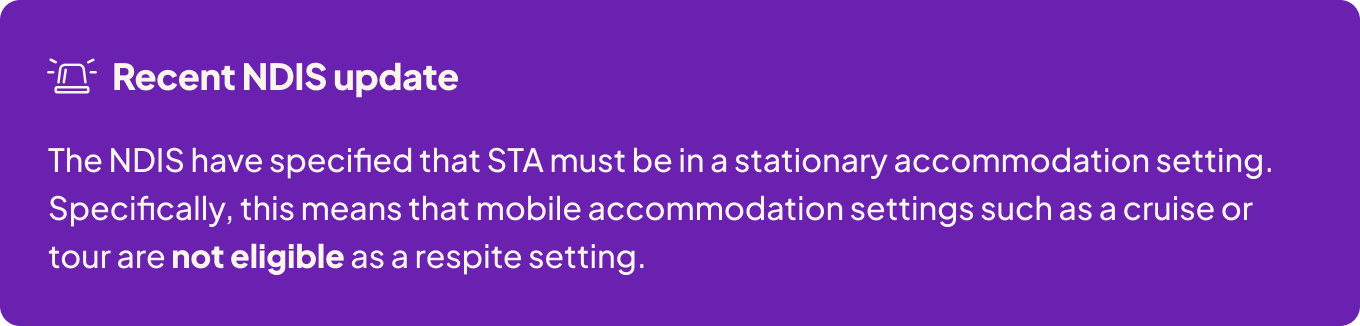
The important thing is that it’s taken in standard, stationary accommodation that is clean, comfortable and provides basic amenities such as a bed, bathroom and any accessibility features required for the participant.
Pricing
NDIS will only cover up to the price limits/caps as set out in the NDIS | Pricing Schedule.
The types of providers that you can use and if you’ll have to pay any out-of-pocket costs are dependent on how your Core funding is managed and other factors.
We encourage you to chat to your LAC, Support Coordinator or Plan Manager so that they can advise you about pricing and if you’ll have to pay anything out of your own pocket.
Subscribe to our newsletter below to stay up-to-date on NDIS changes.
References:
Short term accommodation is now called short term respite | NDIS
Short term respite | NDIS
Short term respite | Download
Pricing arrangements | NDIS
NDIS Pricing Arrangements and Price Limits 2025-26 V1.1